As massage practitioners, it’s important that we look after our own bodies in order to maintain our careers. In this article, we’ll look at self-massage for the wrists – the second most common area that massage practitioners fatigue and strain (after the thumbs, which we looked at massaging in the previous article).
The muscles that cross the wrist
Every time you apply pressure with your hands, it has to be transmitted through your wrists, so the muscles of your forearm that cross the wrist work hard in massage. The main muscles are at the front of the forearm, which flex your wrist and fingers, and those at the back which extend (bend back) your wrist and fingers.
Regular self-massage will help to relax the tension that builds up in these muscles (often without us being aware of it). You probably already have ways of calling on your massage experience to work on these areas. The techniques presented here are all designed to SAVE YOUR THUMBS (the most frequently over-used part of the massage toolkit).
‘Massaging’ the forearm muscles with a small rubber ball
An easy way of ‘massaging’ these muscles is by pressing on a small rubber ball (e.g. a squash ball).

Place the ball on a solid surface and press on it with your forearm. Use your other hand on top to apply comfortable pressure and to move your underneath forearm on the ball. You can easily roll it all over the flexors in the front of your forearm.
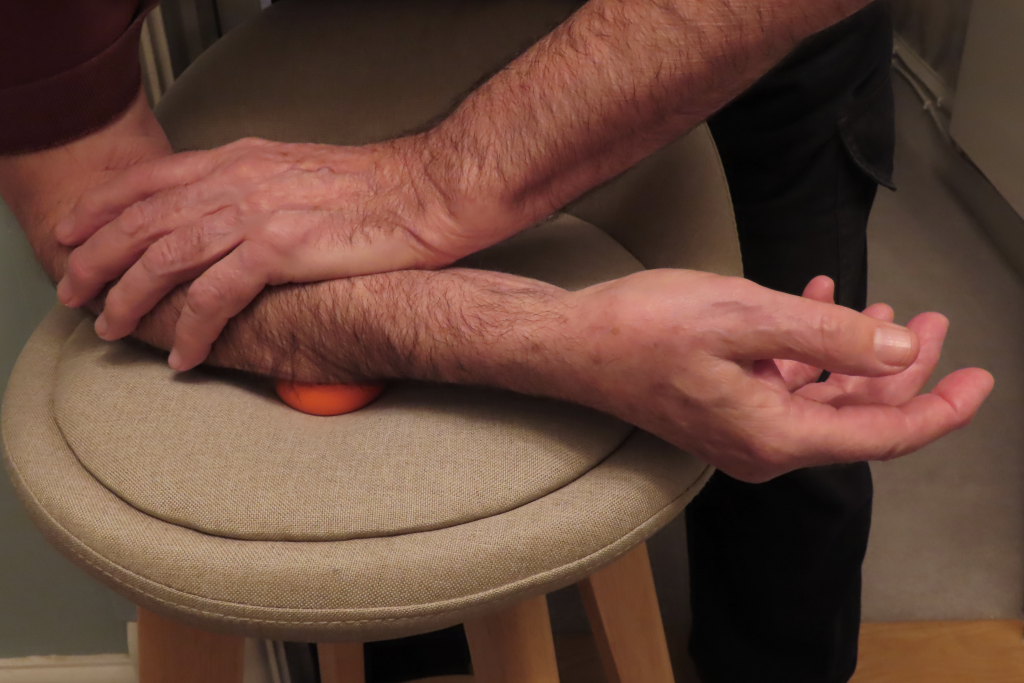
You need to be more careful when you’re pressing down with the back of your forearm. To avoid pressing the ball on your bones (the radius and ulna), which would be uncomfortable, keep it in the ‘groove’ between the bones.
Deep pressure slides on the forearm muscles

It’s fairly easy to use deep tissue slides (from your wrist towards your elbow) which are effective for releasing tension on the front of your forearm (the flexor muscles). Rest your forearm on a solid, cushioned surface (e.g. on your massage table, or on a thick cushion on a table). This enables you to relax the arm that you’re working on. Use the ‘knuckles’ at the base of your fingers (the back of your ‘fist’) or the side of your ‘fist’ (with lightly curled fingers – not clenched).

Whichever of these massage ‘tools’ that you use, take care to keep your wrist as straight as you comfortably can (but not rigidly stiff). When you’re using the ‘knuckles’ of the back of your fist, don’t let your wrist bend too far forward or back. When you’re using the side of your fist, avoid letting your wrist bend sideways.

It’s more challenging on the back of the forearm – to get into the mass of muscles between the bones (the extensors), without grinding on the bones. For many people, it’s most effective to use the ‘knuckles’ of your little and ring fingers of the side of your ‘fist’, to focus the pressure into the ‘groove’ between the bones.
With this technique too, it’s important to keep your wrist relatively straight (to avoid straining it) and have your fingers gently curled.

Squeeze and stretch for the forearm muscles
It’s also useful to stretch these muscles while applying comfortable pressure on them.
An easy way to do this is to squeeze both the flexor and extensor muscles with your other hand (not with your thumb – save it). Then move your hand and wrist around to pull the muscles under the squeeze.
Playing with these techniques
I hope you find these suggestions helpful. Please don’t apply them too rigidly. Play with them to find out how they work best for you, or how you might adapt or blend them with more familiar self-massage techniques.